

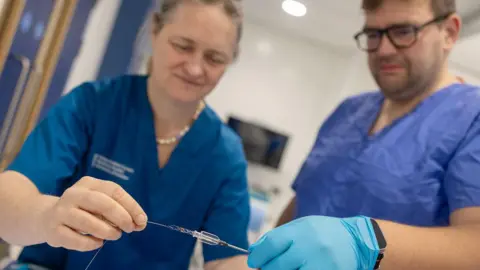
Surgeons from the Scottish region and the United States have successfully completed what is believed to be a world-first stroke surgery utilizing automated systems.
The medical expert, from a research center, executed the remote thrombectomy - the elimination of circulatory obstructions following a brain attack - on a medical specimen that had been provided for research.
The expert was working from a treatment center in the Scottish city, while the subject undergoing procedure via the system was separately situated at the university.
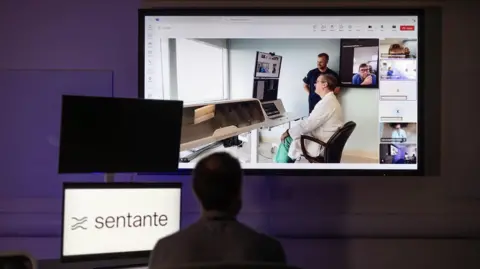
Subsequently, a neurosurgeon from the American state used the technology to conduct the first transatlantic surgery from his Florida location on a donated cadaver in the Scottish city over significant distance away.
The team has called it a potential "game changer" if it gains clearance for medical treatment.
The surgeons consider this innovation could change stroke treatment, as a delay in accessing professional intervention can have a significant effect on the chances of recovery.
"The experience was we were seeing the first glimpse of the next generation," stated Prof Grunwald.
"While in the past this was considered futuristic fantasy, we showed that each phase of the surgery can already be done."
The Scottish institution is the worldwide teaching facility of the international stroke organization, and is the exclusive site in the UK where doctors can treat cadavers with actual blood flowing through the arteries to mimic treatment on a actual patient.
"This was the first time that we could conduct the whole mechanical thrombectomy procedure in a actual human specimen to show that each stage of the surgery are possible," explained Prof Grunwald.
A healthcare leader, the director of a health foundation, described the long-distance operation as "an extraordinary advancement".
"For too long, individuals from isolated regions have been denied availability to surgical intervention," she added.
"Robotics like this could address the disparity which persists in brain care across the UK."
How does the technology work?
An ischaemic stroke happens when an vascular pathway is clogged by a clot.
This interrupts blood and oxygen supply to the neural matter, and neural cells cease working and expire.
The superior intervention is a surgical extraction, where a expert uses surgical tools to clear the obstruction.
But what happens when a person cannot access a professional who can do the procedure?
Prof Grunwald stated the study demonstrated a robot could be linked with the same catheters and wires a specialist would typically employ, and a medical staff who is attending the case could simply attach the instruments.
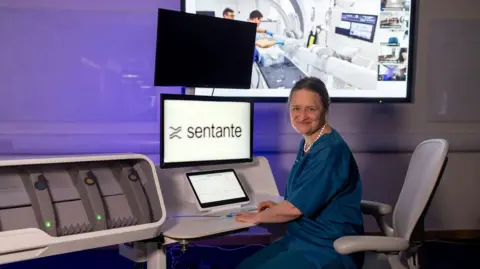
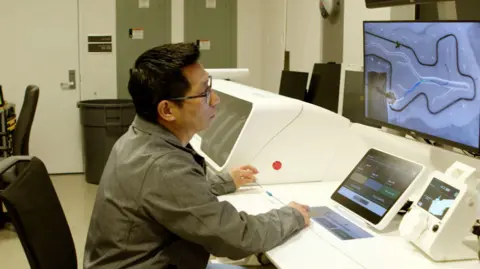
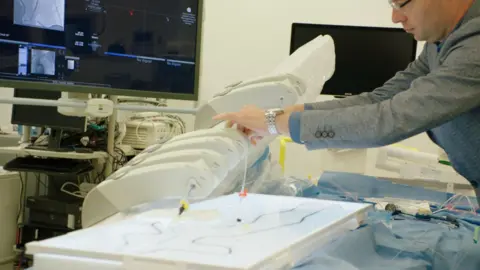
The surgeon, in another location, could then operate and direct their own wires, and the automated system then executes exactly the same movements in real time on the patient to perform the surgical procedure.
The individual would be in a treatment center, while the specialist could carry out the procedure using the advanced machine from anywhere - even their own home.
The medical expert and Ricardo Hanel could view immediate scans of the subject in the experiments, and monitor progress in real time, with the Dundee expert saying it took just a brief period of preparation.
Technology companies Nvidia and Ericsson were involved in the project to ensure the network connection of the automated system.
"To perform surgery from the United States to the Scottish nation with a 120 millisecond lag - a blink of an eye - is absolutely amazing," stated the neurosurgeon.
Advancements in brain care
The medical expert, who has been honored for her work and is also the executive member of the international medical organization, said there were key issues with a conventional clot removal - a global shortage of doctors who can do it, and care is determined by your physical place.
In the region, there are only three places individuals can obtain the treatment - urban centers. If you don't live there, you must travel.
"The procedure is very time sensitive," stated Prof Grunwald.
"Each six-minute postponement, you have a 1% less chance of having a successful recovery.
"This innovation would now offer a new way where you're not depending on where you dwell - preserving the valuable minutes where your cerebral matter is degenerating."
Healthcare information showed there were {9,625 ischaemic strokes|numerous cerebral events|


